- Mar 23, 2025
Fidgets in the Classroom: Learning tool or Distracting Toy?
- Sadie Charlton
- 0 comments
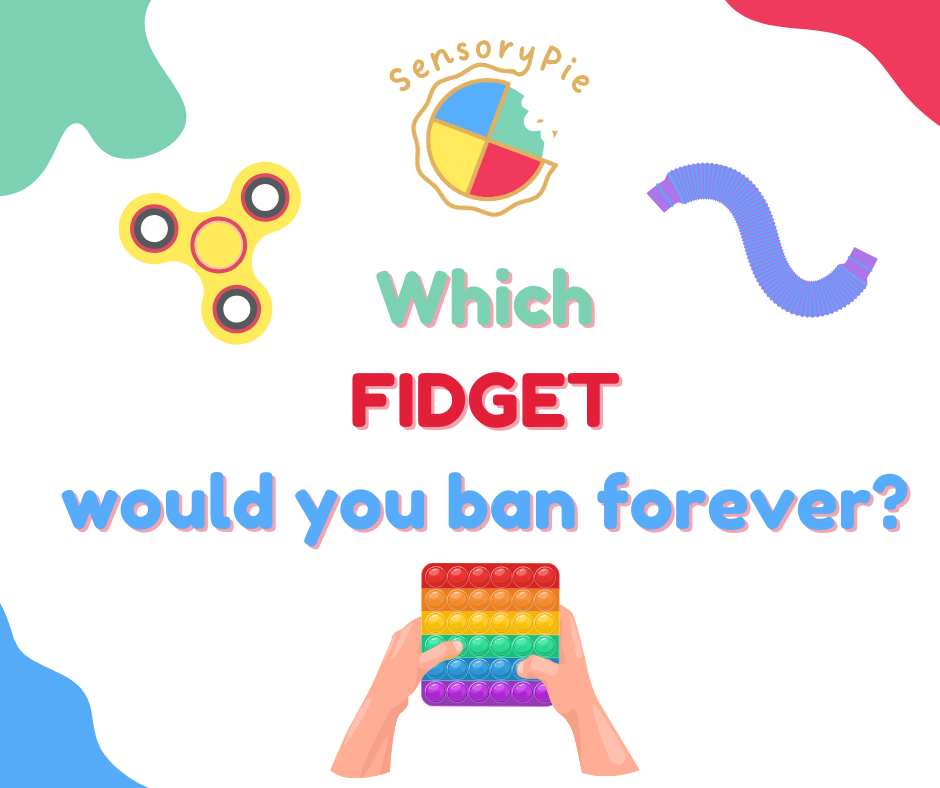
I recently shared the above post on social media, asking followers which fidget they would ban forever.
Turns out, that was a bit of a spicy take! The post was shared, and before I knew it, my comments were full of passionate debates. Some people thought I was advocating for taking away children's coping mechanisms (spoiler alert: I wasn’t). Others even questioned my credibility as an occupational therapist.
But here’s the thing—none of those particularly fiery comments came from anyone who actually works in a primary school classroom. Because if you know, you know!
In this blog post when I'm discussing Fidget TOOLS, I'm not talking about individual coping strategies for specific children whose needs mean they have been recommended a specific tool that is often bespoke and 'prescribed' to their individual need. I'm not talking about taking away strategies that work for children's learning or regulation. I'm referring to the general fidget tools that are becoming more common and widely used in the classroom by many children.
What I See as a Sensory OT
As a Sensory Occupational Therapist working in primary schools, I spend my days visiting different classrooms, observing children with sensory needs, and figuring out what they might need to be successful in learning.
When I observe a child in their classroom, I’m thinking about:
✅ Their sensory needs—are they under-responsive or overwhelmed?
✅ The environment—is the classroom set up to support their regulation and engagement?
✅ The physical demands—do they have the postural control, core strength, and coordination to sit, write, and learn effectively?
✅ Their engagement—are they able to focus and take part, or are sensory challenges getting in the way?
From there, I'm thinking about Sensory Hacks (changes to the environment) and Sensory Snacks (tools, strategies, and activities) to support their regulation and learning.
And that’s where fidgets come in. But not all fidgets are created equal!...
The Reality of Fidgets in the Classroom
In many primary school classrooms, fidgets have become something of a free-for-all. Well-meaning parents often send their children to school with a variety of fidgets, believing they’ll help with focus or regulation. And while this intention is understandable, the reality is much messier. As more and more children come to school with fidgets, the situation starts to feel like a bit of a free-for-all.
As SENDCo, teacher or teaching assistant, it's tough to navigate this space. On one hand, you’re worried about taking fidgets away for fear of being accused of not supporting a child's sensory needs. But on the other hand, the situation becomes unsustainable. Fidgets are distracting, sometimes more to the child’s peers than to themselves, and often (in my experience) they’re used inappropriately. Instead of supporting regulation, they can become a source of dysregulated behaviour. Fidgets get lost, traded, or even stolen, creating more disruptions. Ultimately, what was meant to be a tool for focus becomes a barrier to learning for the entire class. It’s a tricky balance, and it's clear that without some guidance, fidgets can end up causing more harm than good.
What’s the Purpose of a Fidget Tool?
A good fidget tool should:
✔️ Be quiet and safe
✔️ Be used without looking, so the child can still focus on the lesson
✔️ Stay out of other children’s line of sight, avoiding distractions
✔️ Meet the child’s individual sensory needs (some crave textures, others avoid them)
✔️ Fit the child’s physical abilities (if they can’t manipulate it easily, it’s not helpful)
✔️ Be affordable or durable
Which Children Benefit from a Fidget?
Research tells us that many children focus better when movement is included in learning. A well-matched fidget tool can help redirect their need to move so they can engage with learning for longer, more sustained periods.
Children who may benefit from a fidget:
🟡 Those who need extra sensory input to concentrate
🟡 Those who fidget to self-regulate when overwhelmed
🟡 Hypervigilant children who need grounding and body feedback
🟡 Children who pick at skin, bite nails, or engage in self-stimulatory behaviours as a way to self-regulate
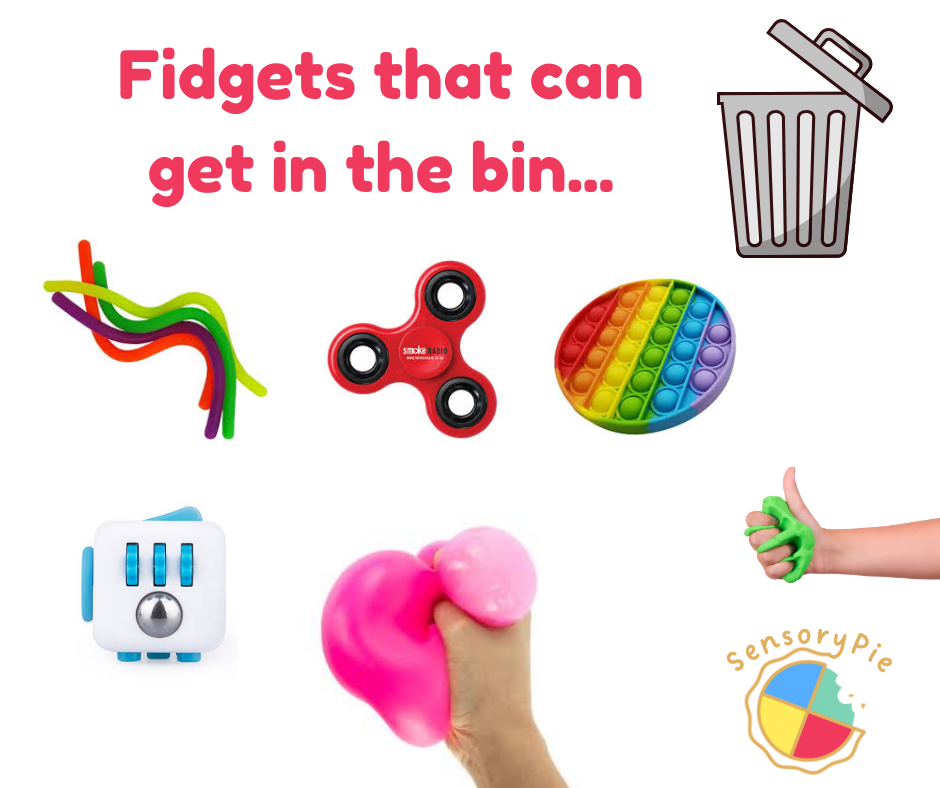
Fidgets That Are Not Tools for Learning
Some fidgets are brilliant in the right setting—but in a busy primary school classroom, they can be disruptive, distracting, or even dangerous. Here are some I’d happily banish from the classroom:
❌ Monkey Noodles – More weapon than fidget. Endlessly flung at heads.
❌ Fidget Spinners – Noisy, visually distracting, and a magnet for peer distraction.
❌ Poppits – Great for a quiet sensory box, not for a classroom.
❌ Slime – This is a classroom, not an episode of Art Attack.
❌ Anything that clicks, spins noisily, bounces, or leaks goo – If it disrupts others, it’s not a tool.
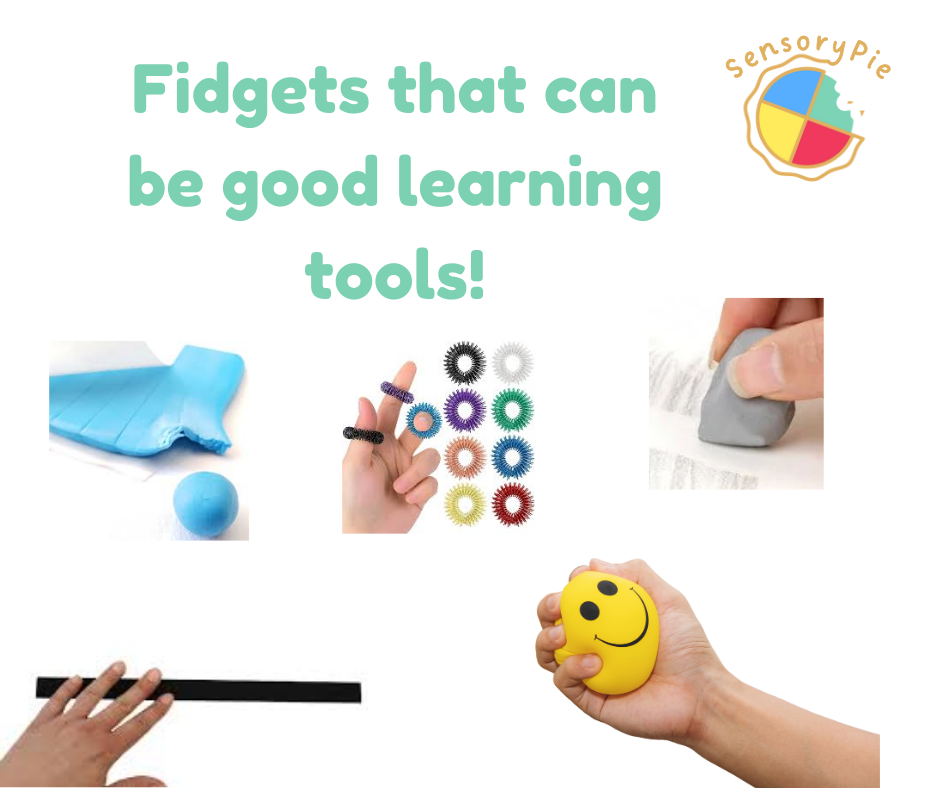
Fidgets That Can Be Helpful Tools for Learning
✅ Blu Tack – Discreet, quiet, and provides great tactile feedback.
✅ Kneadable Erasers – Multi-purpose, practical, and can transition with the child up to secondary school.
✅ Velcro under the desk – A great ‘hidden’ sensory option for tactile seekers.
✅ Stress Ball or Small Foam Squish – One-handed, silent, and great for proprioceptive input.
✅ Spiky Rings – Roll them back and forth on a finger for discreet fidgeting.
Fidgets That Work Well in a Quiet Space or Sensory Breaks
Some fidgets are great, just not for whole-class learning. These can be brilliant in a designated sensory area or for children with a specific need for them:
🔹 Nee-Doh Nice Cube – Heavy, squishy, and freeze-able for extra input.
🔹 Playdough or Putty – Brilliant for deep pressure input.
🔹 Rubik’s Cube or similar visual puzzle fidget – Requires focus and can be helpful to direct hypervigilant eyes.
🔹 Koosh Ball – Fun texture and good for squeezing, but best outside of class time.
🔹 Squishmallows – Soft, comforting, and great for a quiet corner.
Setting Boundaries for Fidgets in the Classroom
Fidgets can be incredibly useful tools—but only when they’re used appropriately. Without clear expectations, they can quickly become a distraction rather than a support. Here are some ideas to help set classroom boundaries around fidget use in the classroom:
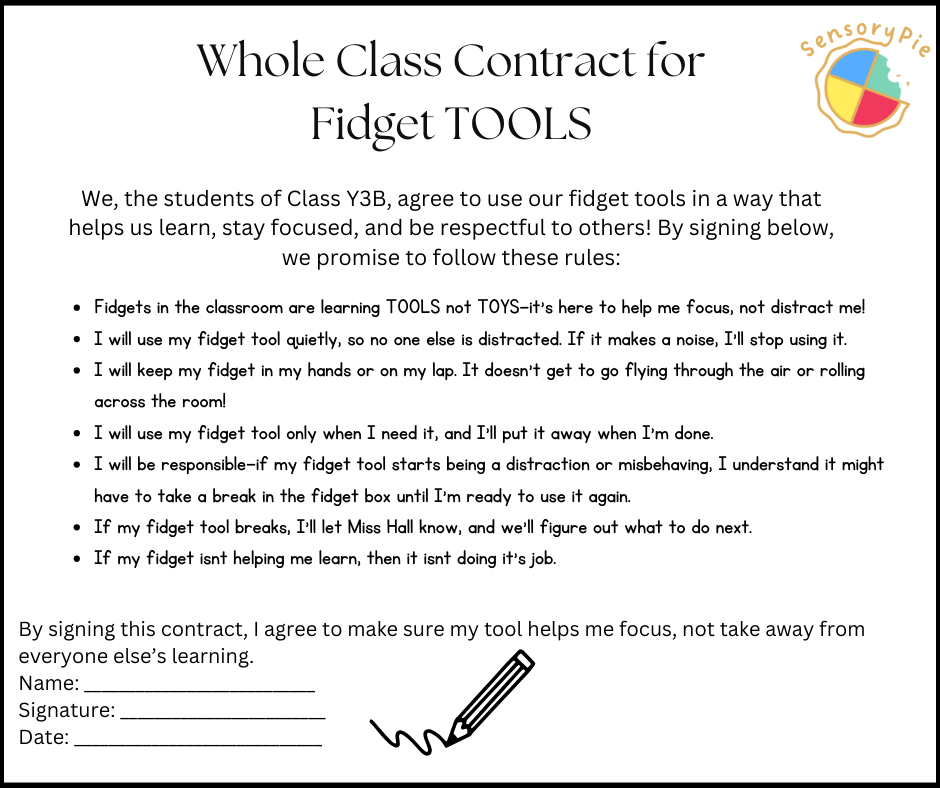
1️⃣ Create a Fidget Tool Contract
A 'Whole Class' Fidget contract, setting clear rules for responsible use. Here are some example rules:
📌 Fidgets are learning tools, not a toys.
📌 I will use my fidget quietly and without distracting others.
📌 I will keep my fidget in my hands or on my lap, not wave it around or throw it.
📌 I will put my fidget away when asked.
📌 If my fidget becomes a distraction, I understand it may be removed.
📌 Fidgets are not for trading
📌 If my fidget isnt helping me learn, then it isnt doing it's job.
It's always helpful to ask the children to create their own contract and agree on this as a class, you can gently direct the rules if you think some helpful rules are missing. For maximum impact, write out the rules on a large piece of flipchart paper and ask everyone in the class to 'sign' the contract.
2️⃣ Store Fidgets in a Central Box
Rather than allowing children to keep fidgets in their trays or pockets, have a central fidget box on each table. Children can take out a fidget when needed, but it should be returned when the task is complete. This helps prevent overuse and encourages thoughtful use of tools.
3️⃣ Designate Fidget-Friendly Times
Some parts of the school day may be more fidget-friendly than others. Consider allowing fidgets during: ✅ Listening to new teaching concepts
✅ Silent or independent work
✅ Moments where extra concentration is needed
But they may not be suitable for:
❌ Group discussions
❌ Writing tasks where both hands are needed
❌ Playtime where they might cause issues in the playground (getting lost, traded, stolen!)
4️⃣ Provide Alternatives for Fidgety Children
Some children might need movement but find fidgets too distracting. Instead, consider:
➡️ Sitting on a wobble cushion
➡️ Providing Theraband on chair legs for foot movement
➡️ Offering movement breaks between tasks
➡️ Sensory circuits BEFORE the learning demand: We've taken the hassle out of planning Sensory Circuits, check out our 100 card resource HERE
The Takeaway
Fidget tools can be game-changing for children who need them. But a fidget is only a tool if it supports learning—otherwise, it’s just another distraction.
Before handing out fidgets in the classroom, ask yourself:
🤔 Does this meet the child’s sensory needs?
🤔 Can they use it without disrupting themselves or others?
🤔 Is there a better way to provide the input they need?
The right sensory strategies can transform a child’s ability to focus and learn. If you’re looking for more ideas on sensory support, check out SensoryPie’s ready-to-use resources, training, and tools for primary schools.
📌 Find out more here: www.sensorypie.com
#SensorySupport #FidgetTools #NotToys #SENDCOlife #PrimaryTeacher #InclusiveEducation